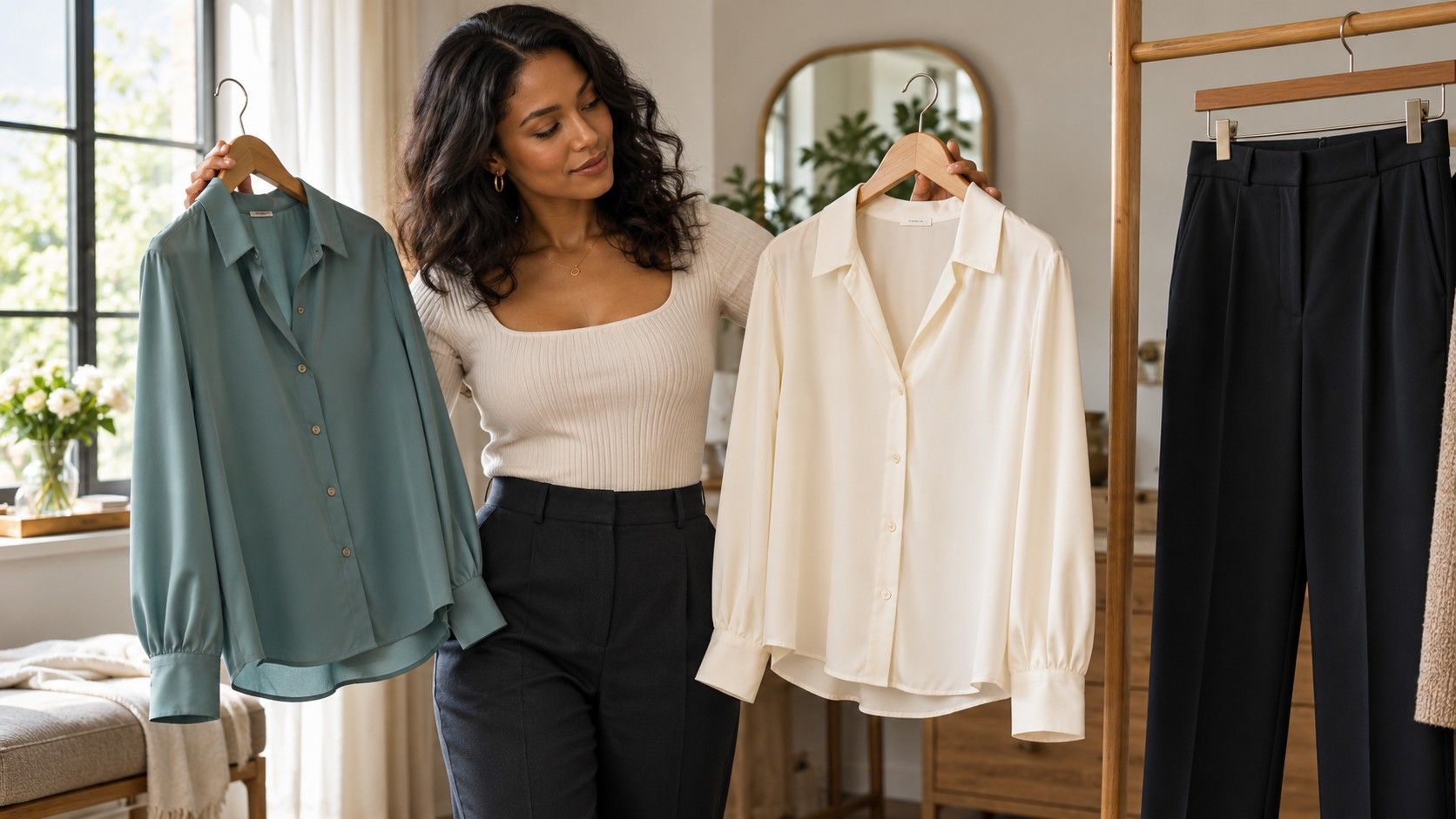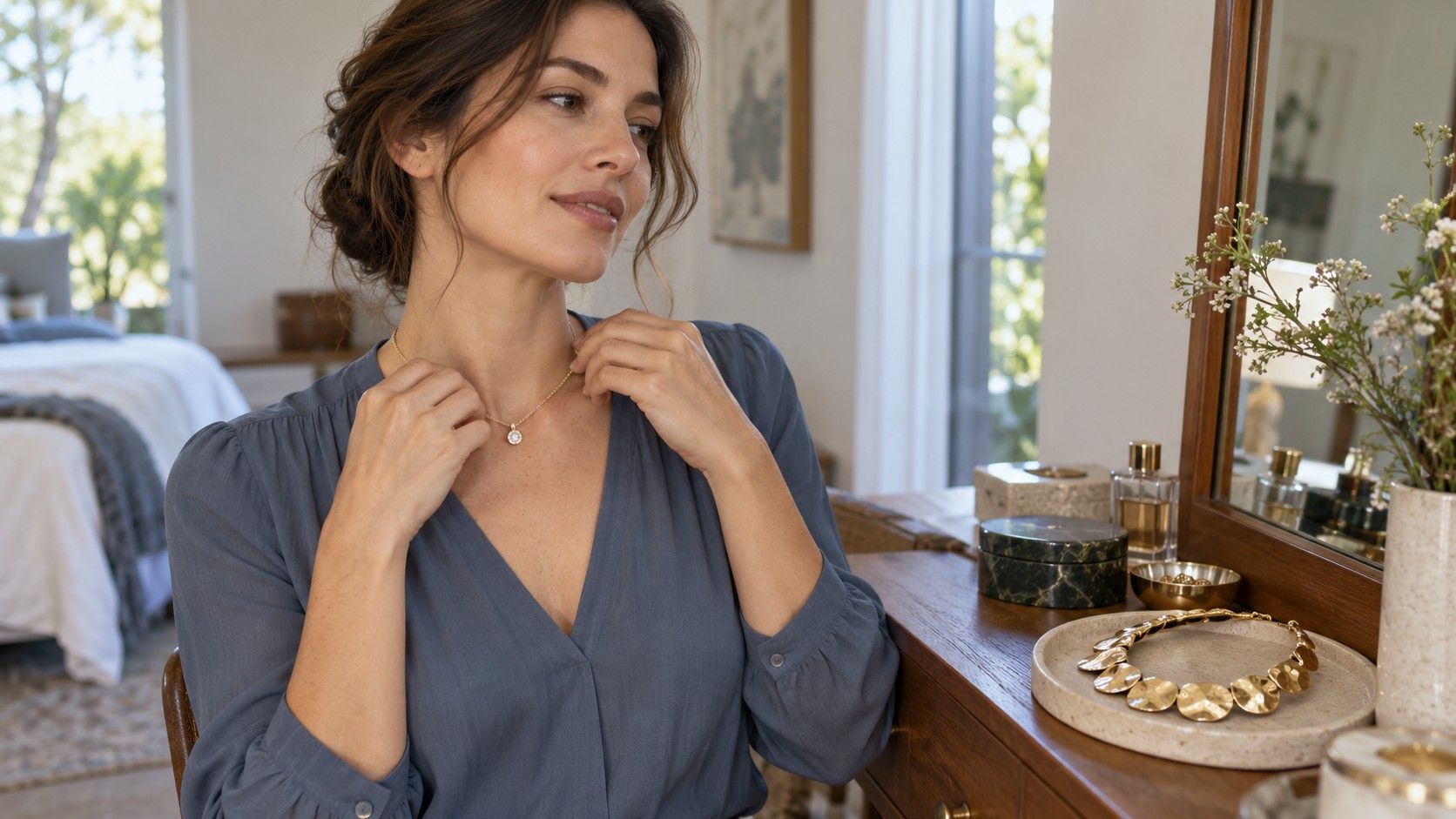
You can love a delicate blouse in a photograph and dislike every minute of wearing it. The sleeves pull, the collar scratches, or the tiny details feel unlike you. When considering style essence vs body type, I find it useful to separate three questions: does the garment fit, do its proportions work with the outfit, and do I enjoy the impression it creates? A label may help describe an answer. It cannot answer all three on its own.
When an outfit feels wrong, check the garment first
A fitted shirt with a romantic collar can fail because its armhole is too shallow. That is a construction problem before it is a style question. Reach forward, sit down and lift your arms in the changing room. Watch whether the buttons pull, the neckline shifts or the shoulder seam restricts movement. If you spend the whole test rearranging the shirt, try another cut or size before deciding that romantic details do not suit you.
The same distinction matters with trousers. A waistband that fits standing up may press when you sit, while excess fabric below it can come from the rise or the pattern. Changing a belt or adding earrings will not solve either issue. Clothing fit depends on the relationship between a particular garment and your body, with enough ease for what you need to do in it. Bodies with similar measurements can still need different adjustments.
Body type can mean several things in style discussions. A body-shape chart describes a limited comparison of proportions; an image-identity system uses its own wider concepts. Neither is interchangeable with a tailor's fitting assessment. Before following advice attached to any label, find out which system the writer means. Otherwise you can end up applying a pear-shape suggestion to an unrelated image identity and wondering why the instructions disagree.
Use essence language to describe an impression you enjoy
People searching for Kitchener style essences are often trying to explain why some details feel convincing and others feel like a costume. John Kitchener's work concerns personal style and color consulting. In everyday wardrobe use, essence language can provide a vocabulary for the impression of an outfit: perhaps restrained, playful, relaxed, dramatic or delicate. Online interpretations vary, so treat a borrowed description as a prompt for experiments rather than a diagnosis.
Consider a plain navy dress worn with two accessory sets. A smooth leather bag and simple metal earrings create one impression; a woven bag and softly textured scarf create another. The dress has not changed its fit, and the wearer has not acquired a new body type. Texture, finish, shape and detail have changed what the outfit communicates. That is a useful place to investigate when the clothes feel comfortable but the styling feels impersonal.
You do not need to establish an essence percentage before making a useful choice. Save a few outfits you would actually wear to the office, a weekend lunch or a concert. Write down the specific details that attract you: rounded buttons, a crisp collar, irregular texture, a large cuff. A folder described only as “my essence” is hard to shop from. A note saying “soft collar, matte fabric, one substantial accessory” gives you something you can test.
Give each wardrobe question a suitable tool
A helpful system earns its place by making a decision easier. When several labels are competing for your attention, identify the actual difficulty before reaching for another quiz. The table separates common situations without assigning anyone a permanent category.
| What you notice | What to check first | A useful experiment |
|---|---|---|
| A blouse pulls when you reach | Size, armhole, shoulder and sleeve construction | Try a different cut with the same decorative details |
| The outfit feels unlike you | Texture, accessories and degree of detail | Keep the clothes and change one accessory set |
| Separate pieces work but the outfit feels awkward | Lengths, volume and where edges meet | Change the top length or shoe with everything else fixed |
| A color seems difficult near your face | Color preference and how it looks in ordinary light | Compare two scarves with the same neckline |
| You like the photograph but avoid wearing the outfit | Comfort, maintenance and the day's activities | Wear it at home through sitting, walking and carrying a bag |
These questions can overlap. A heavily embellished neckline may feel awkward because it is stiff, because you dislike the ornament, or because a necklace catches on it. Describe the problem literally before interpreting it. “I keep touching the collar” is a better starting observation than “my essence blend is wrong.” The first statement leads to a change you can evaluate.
Test a new direction without replacing your wardrobe
Start with an outfit you already wear happily. A pair of trousers and a familiar knit gives you a reasonably stable base. To explore a more graphic impression, try angular earrings or a bag with a clear shape. To explore a gentler impression, change to a softly folded scarf or a less rigid bag. These are examples of visual effects, not exclusive assignments to particular people.
Make one change at a time and use the same mirror, lighting and camera position if you take photographs. A different pose or a tilted phone can make the comparison less useful. Check the outfit while moving as well: a scarf that looks beautiful for one still image may slide into your lunch or need constant adjustment. You are choosing something to live in, so a useful result should survive more than a photograph.
Give the experiment a real destination. Wear the earrings to a short errand, the scarf to lunch or the structured bag on a normal workday. Afterwards, note whether you felt comfortable, enjoyed the look and wanted to repeat it. A detail can be attractive and still be inconvenient for your routine. Borrowing an accessory or trying an item you already own keeps an uncertain style idea from becoming an expensive commitment.
Adjust the amount of detail before rejecting the idea
Sometimes the direction is appealing but the dose is wrong. If a large ruffle feels distracting, try a softer collar edge or a single gathered seam. If a sharply tailored jacket feels too formal, try a simpler jacket with a clean front and a fabric that moves more easily. You can retain the quality you like while changing its scale, placement or intensity.
Scale is relational. A small pendant may disappear against a heavily patterned top yet be visible against a plain knit. A broad cuff may work well on its own but compete with a busy sleeve. Check the whole arrangement before deciding that your body requires a particular accessory size. The garment, surrounding detail and occasion all affect how noticeable an item becomes.
Mixing impressions is also ordinary. A crisp shirt with worn-in jeans can feel more natural for a casual office than either a complete tailored look or a complete relaxed look. Keep one point of continuity, such as a repeated color or similar level of formality, and see whether the combination feels intentional to you. There is no need to make every item tell exactly the same story.
Keep a formula that works on an ordinary morning
Once an experiment succeeds, record the outfit in terms you can repeat: straight trousers, an easy knit, a smooth bag and one curved metal accessory. Add the fit detail that mattered, such as a top ending above the pocket or sleeves that remain comfortable under a jacket. This is more useful in a shop than trying to remember a long list of permitted garments.
Build two or three versions for your actual week. A work formula may need a washable top and shoes you can walk in; a dinner formula may allow a delicate fabric or larger earrings. They can share an impression without sharing every item. If your preferred details change with your haircut, job or mood, revise the formula. Personal style is allowed to respond to life.
I would keep a system only while it reduces friction. When a label makes you distrust a comfortable, much-loved outfit, return to the evidence in front of you. Check fit, compare proportions, name the detail you enjoy and wear the clothes for a normal day. Style essence and body-type language can support those decisions, but your wardrobe needs to work even when you cannot settle on a category.